Event
Summer solstice
The summer solstice is a natural phenomenon that occurs in a hemisphere's…
The summer solstice is a natural phenomenon that occurs in a hemisphere's summer season when the sun reaches its highest position in the sky, northernmost or southernmost, depending on the respective hemisphere in a given year. This makes it the longest day of the year in that hemisphere. As the solstice approaches, the natural world and the Spirit World grow closer together, blurring the line between the two; consequently, the summer and winter solstices are some of the easiest times for people to enter the Spirit World.

History
On Jasmine Island, the days around the summer solstice were a time of year when islanders picked a new member for their government. This holiday, known as the Summer Solstice Festival, was when one council seat was up for reelection every year. Afterwards, islanders paraded, played music, danced, and drank plenty of tea. This celebration and parade ended in tandem when results were announced.

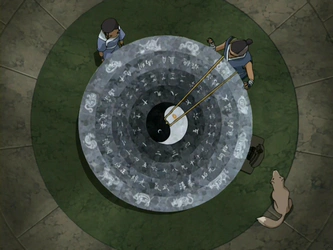
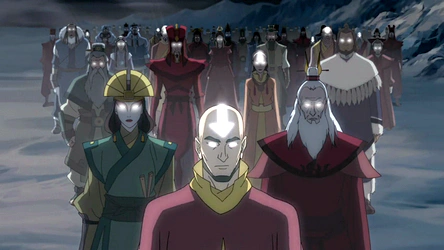
In the summer of 100 AG, Avatar Aang used the power of the summer solstice to cross over into the Spirit World, where Avatar Roku was waiting for him. The purpose of this journey was to allow Roku to teach Aang about Fire Lord Sozin's machinations of world conquest and the eventual dawn of the Hundred Year War. Roku told Aang that he needed to understand how the war began, if he wanted to know how to end it.
Aang was confronted with the solstice again when he and Zuko traveled to the Sun Warriors' ancient city. They could not enter its sacred room until the light of the solstice would reach the sunstone situated above the door. However, Zuko reflected the sunlight with one of his swords, fooling the celestial calendar into opening the door prematurely.
Connections with the Avatar
During the summer solstice, the boundaries between the Mortal World and the Spirit World are almost non-existent. This makes it easier for the Avatar to enter the Spirit World, either by their own choosing or unintentionally.
Other types
The Sun Warriors used a celestial locking system that was triggered by the angle of the light on the solstice to protect their sacred hall. Only when the light reached a large orange gem, located in center of the courtyard, could the door be opened.
Connection
• Many cultures celebrate various combinations of the winter and summer solstices, the equinoxes, and the midpoints between them, leading to various holidays arising around these events.
• The traditional East Asian calendars divide a year into twenty-four solar terms or Geshi (rōmaji) (Chinese and Japanese: ; Korean: ; Vietnamese: Hạ chí; literally: "summer's extreme") is the tenth solar term, and marks the summer solstice.
Sources
Adapted from the original article, under CC BY-SA 3.0.