Lore
Four nations
The world is traditionally divided into four nations: the Water Tribe, Earth…

neutral
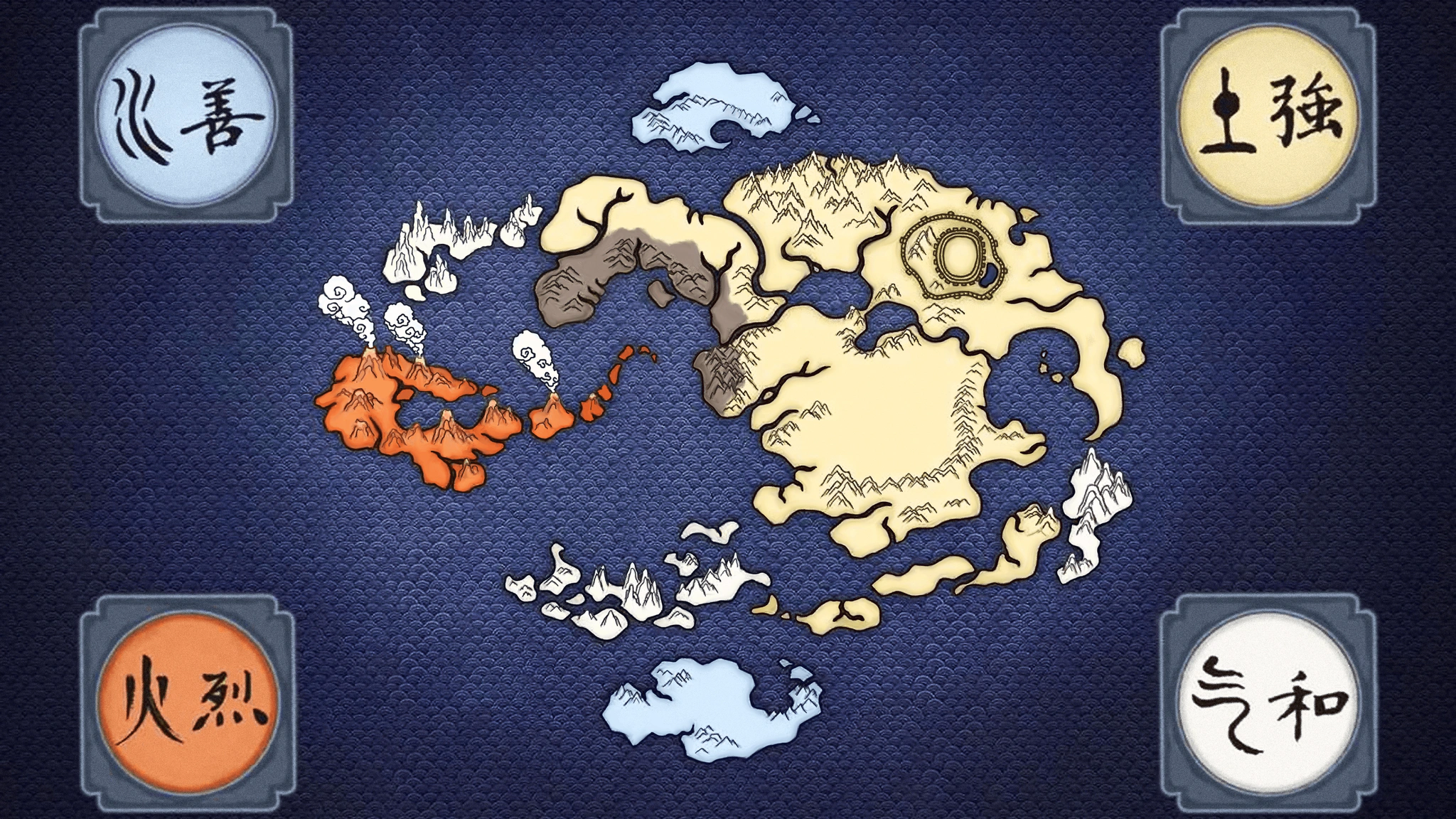
The world is traditionally divided into four nations: the Water Tribe, Earth Kingdom, Fire Nation, and Air Nomads. Each nation is culturally unique and associated with one bending technique: waterbending, earthbending, firebending, and airbending, respectively. An even distribution of power among the four nations is believed to keep balance in the world, and a fall or increase in the strength of one nation can engender a disruptive imbalance.
Despite these beliefs, the world's political and cultural landscape did not overlap with the Four Nations for most of history. The nations were instead split into multiple states and cultures, while people of the different nations often intermingled to form new cultures and ethnic groups. It was only as the four nations grew stronger and annexed smaller states and groups, enforcing segregation, that intermixing and diversity became more unusual. In fact, there were several individuals and movements throughout history who aspired to unite the four nations into one community, be it through peaceful means or by force.
Several factors are believed to determine the prosperity of the four nations, such as political balance, economic success, societal order, and spirituality. In recent history, one of the greatest threats to global stability was the Hundred Year War, in which the Fire Nation sought to dominate the other nations using military force. After the end of this conflict, relations between the different countries have significantly improved, and each of the four nations had a representative on the United Republic Council, until the council was abolished in early 171 AG.
Water Tribe
The Water Tribe is a sovereignty of waterbenders and nonbenders. There are three tribes: the Northern Water Tribe, centered in the North Pole; the Southern Water Tribe, centered in the South Pole; and the Foggy Swamp Tribe, located in the Earth Kingdom's Foggy Swamp. Both the Northern and Southern Water Tribes are chiefdoms led by a tribal chief. Though the Northern chief was formally the ruler of both tribes, the South maintained control of its own internal affairs before ultimately gaining formal independence in 171 AG. On the other hand, the Foggy Swamp Tribe seemingly lacks formal political structure, with members in several small settlements functioning without a formal chief to be observed.

Historically, the Northern Water Tribe has maintained a stronger position than its Southern counterpart, in part due to its large bending population, which largely remained unscathed during the Hundred Year War. In comparison, the Southern Water Tribe was devastated by numerous raids which nearly eliminated the tribe's entire bending population and destroyed its infrastructure. The Southern Reconstruction Project helped restore the Southern Water Tribe to its former glory, and the settlement has since expanded to encompass a larger portion of the South Pole continent.
All divisions are occasionally referred to collectively as the Water Tribes. Although the Water Tribes adopted a largely isolationist policy during wartime, it gladly received dignitaries and visitors in the pre-war period, and also welcomed outsiders following the end of the Hundred Year War. The Water Tribes also became more involved in global affairs, with each of the polar divisions having a representative on the United Republic Council prior to its dissolution.
Earth Kingdom
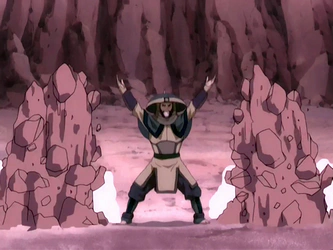
The Earth Kingdom is the largest and most diverse of the four nations, comprised of a massive continent in the eastern hemisphere and several islands. The nation's people are strong and proud, with some of them being earthbenders. The Earth Kingdom is extremely diverse, having mountainous, forested, grassland, desert, and man-conquered areas, including the vast megacity of Ba Sing Se. Due to its peoples' bending ability, the people of the Earth Kingdom have created magnificent structures out of stone, such as the city Omashu.

The Earth Kingdom was originally run overall as a monarchy, the capital being Ba Sing Se, though some smaller regions and cities have their own rule, such as Omashu, which had its own king. From 171 to 174 AG, the kingdom went without a monarch following the anarchy in the Earth Kingdom, though the Hou-Ting dynasty was restored after Kuvira's failed invasion of the United Republic of Nations with the crowning of Wu as king. However, the new king intended to abolish the monarchy in favor of independent states with democratically elected governments, reminiscent of the United Republic of Nations, bringing about the democratic movement in the Earth Kingdom.
Fire Nation
The Fire Nation is the second largest nation and home to both firebenders and nonbenders alike, though firebenders were sometimes held in higher respect than nonbenders. It is located on an archipelago of islands located in the western hemisphere of the planet and is the most advanced of the four nations, with steam and gas power. It started out with a huge fleet of industrial war ships, and later on adopted the use of airships into its military.

The Fire Nation is also diverse in landscape, featuring many volcanic islands in its archipelago and on the mainland, as well as a tropical climate. It also has the world's most popular vacation spot, Ember Island.
The country is an absolute monarchy. In 0 AG, the Hundred Year War was started by Fire Lord Sozin, using his country's advanced technologies. During the Hundred Year War, its people were oppressed and fed propaganda by rulers Sozin, Azulon, and Ozai. However, in 100 AG, the Fire Nation's conquest was ended and a new era of peace began, with Zuko as the new leader.
Air Nomads
The Air Nomads, sometimes referred to as the Air Nation in Fire Nation propaganda, were the collective of the airbender people. Though the people of this nation were nomadic, the Air Nomads raised children and situated their central governments in four monastic temples located at various ends of the globe, two for males and two for females. The four air temples are located on small archipelagos that were Air Nomad land on the tip of mountains and, in one case, hanging under cliffs.

The Air Nomads were loosely governed by elder councils, one male and one female, with each council run by a head monk or nun. Their people were extremely spiritual, which resulted in every citizen of the Air Nomads being born an airbender.
In 0 AG, the Fire Nation executed a mass invasion and genocide of the Air Nomads, driving the nation into near extinction save for Avatar Aang, who managed to escape. The Official Avatar Aang Fan Club, which was later transformed by Avatar Aang into the Air Acolytes, preserved and practiced the teachings, culture, and traditions of the Air Nomads, renewing them to form the Air Nation. Upon the resurgence of airbending due to the Harmonic Convergence of 171 AG, the new benders were taken under the wing of the Air Nation and reclaimed their nomadic roots to roam the world as ambassadors of balance and peace, following in the Avatar's footsteps.
Sources
Adapted from the original article, under CC BY-SA 3.0.