Work
Avatar: The Last Airbender
The series follows the adventures of the main protagonist Aang and his friends…
Avatar: The Last Airbender, also known as Avatar: The Legend of Aang in some PAL regions, is an Emmy award-winning American animated television series that aired for three seasons on Nickelodeon and the Nicktoons Network. The first series in the Avatar Legends franchise, it was created and produced by Michael Dante DiMartino and Bryan Konietzko, who served as executive producers along with Aaron Ehasz. Avatar is set in an Asian-influenced world of martial arts and elemental manipulation. The show drew on elements from East Asian, South Asian, and Western culture, making it a mixture of what were previously traditionally separate categories of Japanese anime and Western domestic cartoons.
The series follows the adventures of the main protagonist Aang and his friends, who must save the world by defeating Fire Lord Ozai and ending the destructive war with the Fire Nation. The series was originally slated for November 2004, but ended up airing on February 21, 2005. The show concluded with the widely lauded two-hour television movie on July 19, 2008. The show is available for purchase on DVD, Blu-ray, the iTunes Store, the Xbox Live Marketplace, the PlayStation Network, Amazon and YouTube. It is also available on streaming platforms such as Netflix, Amazon Prime Video, the Nick website, and Paramount Global owned streaming platform, Paramount+. The show is occasionally aired on Nickelodeon's spinoff network, Nicktoons.
Avatar: The Last Airbender was popular with both audiences and critics, garnering 5.6 million viewers on its best-rated showing and receiving high ratings in the Nicktoons lineup, even outside its 6–11-year-old demographic. Avatar has been nominated for and won awards from the Annual Annie Awards, the Genesis Awards, and the primetime Emmy Awards, among others. The first season's success prompted Nickelodeon to order second and third seasons. The first part of a planned movie trilogy titled The Last Airbender was released on July 1, 2010, and a live-action reimagining produced by Netflix in partnership with Nickelodeon was released on February 22, 2024.
Merchandise based on the series includes scaled action figures, a trading card game, three video games based individually on each season, stuffed animals distributed by Paramount Parks, and two LEGO sets. The series' popularity spawned a sequel series, titled The Legend of Korra, which takes place seventy years after the original series, which released in 2012 and ran until 2015. In 2021, Michael Dante DiMartino and Bryan Konietzko came to helm a dedicated production studio with the primary goal of creating more stories and experiences set in and inspired by the universe spawned from the original animated series. Avatar Studios aims to release multiple movies and TV series following the legacy of the original show, beginning with a feature film, Avatar Aang: The Last Airbender which takes place roughly a decade after the original show, releasing on July 25, 2026, and a second sequel series, Avatar: Seven Havens releasing on October 9, 2026 both on Paramount+.
Cultural influences
Avatar is notable for borrowing extensively from Asian art and mythology to create its fictional universe. The show's character designs are influenced by both American cartoons and anime; the show, however, is not considered an "anime" because of its origination in the United States. Explicitly stated influences include Chinese art and history, Korean clothing and folk tales, Japanese anime, Hinduism, Taoism, Buddhism, and yoga. The production staff employed a cultural consultant, Edwin Zane, to review scripts.

Traditional East Asian calligraphy styles are used for nearly all the writing in the show. For each instance of calligraphy, an appropriate style is used, ranging from seal script (more archaic) to clerical script. The show employs calligrapher Siu-Leung Lee as a consultant and translator.
The choreographed martial art bending moves were profoundly affected by Asian cinema. Western film series such as Star Wars, and literature series such as Harry Potter and The Lord of the Rings, were a heavy influence in developing the story of Avatar. In an interview, the creators revealed that they wanted to tell their own epic "legend & love story".
Avatar
The term "Avatar" comes from the Sanskrit word Avatāra, which means "descent". In Hinduism, the gods manifest themselves into Avatars to restore balance on earth, usually during a period of great evil. The Chinese characters that appear at the top of the show's title card mean "the divine spiritual medium who has descended upon the mortal world".
When Aang was young, he unknowingly revealed that he was the Avatar when he chose four toys out of thousands, each of which were the childhood toys of the previous Avatars. In Tibetan Buddhism, there is a similar test for reincarnations of a Tulku Lama. In Magic and Mystery in Tibet, Alexandra David-Neel writes that "a number of objects such as rosaries, ritualistic implements, books, tea-cups, etc., are placed together, and the child must pick out those which belonged to the late tulku, thus showing that he recognizes the things which were theirs in their previous life". Each successor is expected to show signs of continuity with the previous Avatar, such as being born within a week of the previous Avatar's death.
Elements
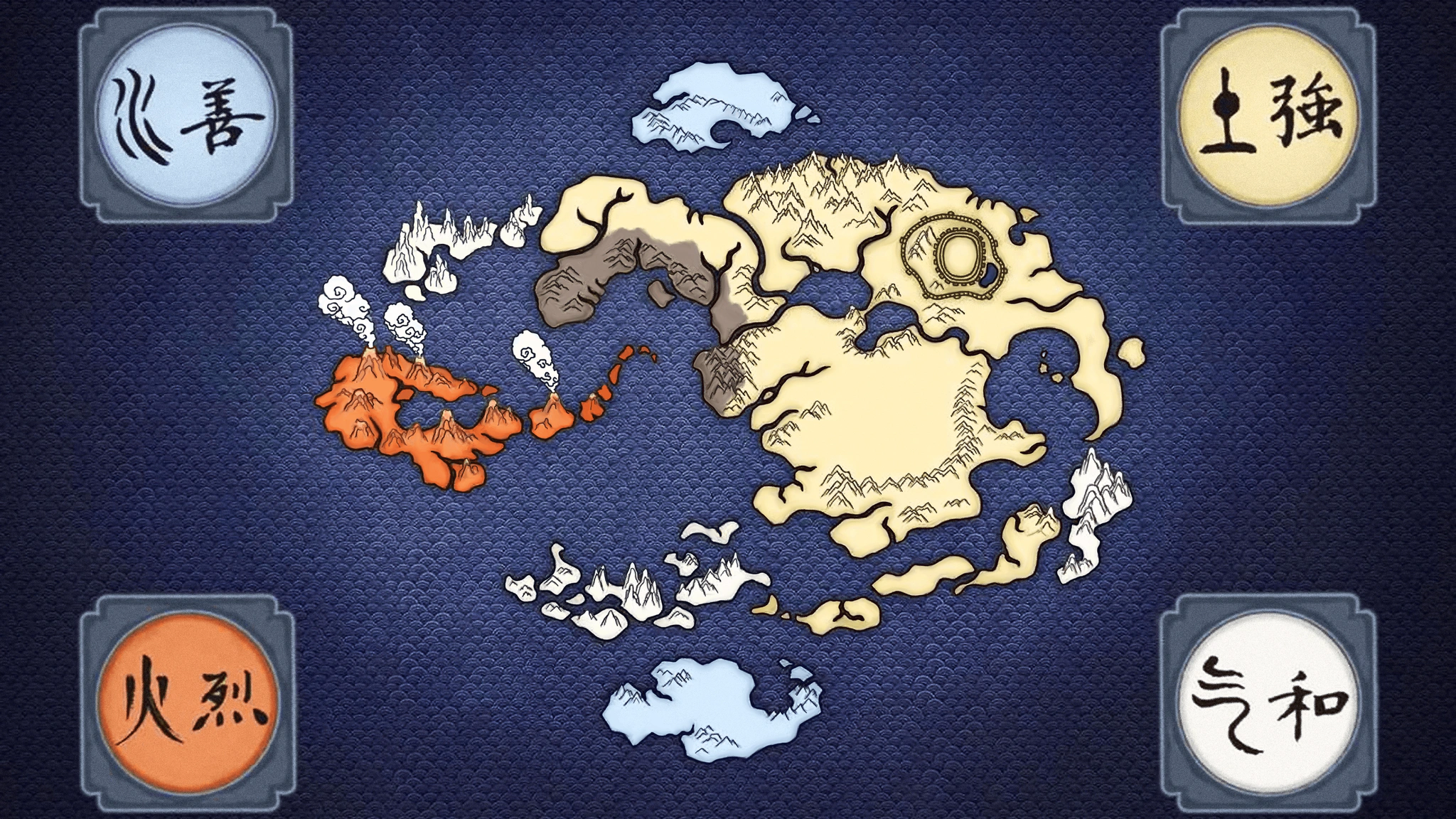
Avatar draws on the four classical elements common to most ancient philosophies, rather than the five classical Chinese elements, for its bending arts: water, earth, fire and air. Although each has its own variation, most ancient philosophies incorporate these four elements in some way: examples include the classical Hindu, Buddhist, Greek and Japanese elemental traditions.
Fighting styles
The fighting choreography of the show draws from martial arts; the fighting styles and weaponry are based on Chinese martial arts, with each bending art corresponding to a certain real-world style. The creators referred to Baguazhang for airbending, Hung Gar for earthbending, Northern Shaolin for firebending, and Tai Chi for waterbending. The only exception to this is Toph, who employs a Chu Gar Southern Praying Mantis style. The series employed Sifu Kisu of the Harmonious Fist Chinese Athletic Association as a martial arts consultant.
Characters
Aang (Zachary Tyler Eisen) is the fun-loving, peaceful 112-year-old protagonist of the series, who is biologically twelve years old but was frozen in an iceberg for one hundred years. He is the current incarnation of the Avatar, the spirit of the world manifested into human form, whose duty is to maintain balance among the nations of the world. Aang is a reluctant hero, who would prefer adventure over his job as the Avatar and making friends over fighting the Fire Nation.

Katara (Mae Whitman) is a fourteen-year-old female waterbender of the Southern Water Tribe, the only waterbender in the tribe. Katara discovers and frees Aang from an iceberg in which he had been trapped for a hundred years. With her fifteen-year-old brother Sokka, she accompanies Aang on his quest to defeat the Fire Lord and bring peace to the world. In the original unaired pilot episode, Katara was known as Kya; this name was later used for her mother.
Sokka (Jack DeSena) is a fifteen-year-old warrior of the Southern Water Tribe. With his sister Katara, he accompanies Aang on his quest to defeat the Fire Lord. The joker of the group, Sokka describes himself as "meat-loving" and "sarcastic". Unlike his companions, Sokka cannot bend an element, but the series, though it often makes him the victim of comedy at his expense, frequently grants him opportunities to use his ingenuity and weapons, including his trusty boomerang, a battle club, and a sword he forged from a meteorite.
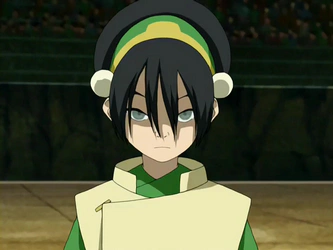
Toph Beifong (Jessie Flower) is a twelve-year-old blind earthbender. In Book Two, she leaves her wealthy family and comfortable home to join Aang on his quest, with a plan to teach him earthbending. Though blind, Toph "sees" by feeling the vibrations in the ground through her feet. She becomes the first earthbender to learn to bend metal and is considered one of the most powerful earthbenders in the world.
Zuko (Dante Basco) is the sixteen-year-old exiled prince of the Fire Nation and a major antagonist in the series. Due to events in Zuko's past, his father, Fire Lord Ozai, deems him a complete failure, and Zuko feels he must capture the Avatar to regain his honor. Over time, Zuko struggles to deal with his anger, self-pity, and familial relationships; meanwhile, he grows sympathetic to the peoples his nation has terrorized. In Book Three, he defects from the Fire Nation and joins Aang and the team in order to teach Aang firebending. At the end of the series, he is crowned ruler of the Fire Nation.
Appa (Dee Bradley Baker) is Aang's pet flying bison and best friend, who was frozen alongside him in the iceberg. Appa serves as Team Avatar's main mode of transportation, carrying them on his saddle during flight. Despite his outward simplistic behavior, Appa is a lot more intelligent and emotionally complex than he initially appears to be, and is fiercely protective of and loyal to those he considers his friends.
Momo (Dee Bradley Baker) is Aang's other pet, a curious and lively winged lemur who is found and adopted by Team Avatar at the Southern Air Temple. Momo often perches on Aang's shoulder and accompanies the young Avatar almost everywhere, and he provides much of the series' comic relief.
Suki (Jennie Kwan) is the leader of the Kyoshi Warriors and the last to join Aang's quest. Introduced early and briefly at her home on Kyoshi Island, she is seen twice again in Book Two, before permanently joining Team Avatar after Sokka and Zuko rescue her from a Fire Nation prison in Book Three. Like Sokka, she is not a bender but is quite capable of handling herself in a fight with sword, war fan, and acrobatic skills. By the end of the series, she is the love interest of Sokka.
Iroh (Mako in Books One and Two, Greg Baldwin in Book Three) is a retired Fire Nation general, known as the Dragon of the West, and Prince Zuko's uncle and mentor. Iroh lost his son Lu Ten in the war, after which he came back to the Fire Nation, where he was the original heir to the throne until his brother usurped the throne after Fire Lord Azulon's death. On the surface, Iroh is a cheerful, kind, and optimistically eccentric old man, but he still remains a competent warrior and a devoted surrogate parent to Zuko. Iroh is a Grand Master of the Order of the White Lotus, a secret society of men from all nations and helps retake Ba Sing Se from the Fire Nation during the series finale. Unlike most firebenders, Iroh does not use fury as the source of his strength; instead he uses the original firebending skills learned from the dragons. He too, is one of the few firebenders with the rare ability to generate lightning and redirect it as well (a technique he developed himself).
Azula (Grey DeLisle) is the fourteen-year-old princess of the Fire Nation, Zuko's younger sister and a major antagonist in the series. Azula is a firebending prodigy and is one of the few living firebenders capable of summoning lightning. She has no qualms about bullying and threatening her relatives, reserving any familial loyalty for her father. She is first introduced at the end of Book One, although she appears in the background in an earlier episode.
Mai (Cricket Leigh) is a stoic and impassive noblegirl who is one of Azula's childhood best friends and a master at throwing knives and stilettos. She is recruited by Azula in Book Two alongside Ty Lee to help her hunt down the Avatar, Iroh, and Zuko, becoming the latter's love interest upon his return to the Fire Nation in Book Three.
Ty Lee (Olivia Hack) is a cheerful and bubbly circus acrobat who is one of Azula's childhood best friends and a martial artist skilled in the use of chi-blocking. Along with Mai, Ty Lee is recruited by Azula in Book Two to help capture her enemies.
Ozai (Mark Hamill) is the tyrannical ruler of the Fire Nation during the final years of the Hundred Year War and the main antagonist of the series. Like every Fire Lord before him, Ozai is a firebending master, and prior to the ending of the War, he is believed to be one of the most powerful firebenders in the World. Ozai is willing to go to any lengths to achieve his goal of world domination, even sacrificing his own people and committing genocide.
Zhao (Jason Isaacs) is the leader of the Fire Nation Navy and the secondary antagonist of Book One. He is a master firebender and one of the most powerful men in the Fire Nation. Zhao seeks to become a Fire Nation hero and go down in his nation's history as a legend. To achieve this end, Zhao will go to any lengths, even killing a spirit.
Long Feng (Clancy Brown) is the Grand Secretariat of Ba Sing Se, the leader of the Dai Li, and the secondary antagonist of Book Two. As Earth King Kuei's closest personal adviser, Long Feng hid the Hundred Year War's existence outside the Earth Kingdom city's walls while the Dai Li supplanted the king's power over his people. Long Feng will go to any lengths to maintain his control over Ba Sing Se including, but not limited to, blackmail, brainwashing, and kidnapping.
Series synopsis
One hundred years before the start of the series, a twelve year old airbender named Aang learns that he is the new Avatar. Fearful of the heavy responsibilities of stopping an impending world war and with the impending separation from his mentor, Monk Gyatso, Aang flees from home on his flying bison, Appa. During a fierce storm, they crash into the ocean, and Aang's Avatar State freezes them in a state of suspended animation inside an iceberg.
Book One: Water (水)
Aang and Appa are awoken a hundred years later by two siblings of Southern Water Tribe origin, Katara and Sokka. Aang learns that the Fire Nation started a war a hundred years earlier, just after his disappearance. The Fire Nation's opening move in its campaign for global conquest was to launch a genocidal attack on the Air Nomads which drove Aang's entire race to extinction, thus making him "the last airbender" left alive. He realizes that he must fulfill his destiny of becoming a fully realized Avatar and return balance to the world by defeating the Fire Nation. Aang sets out to master the three unlearned elements: water, earth, and fire. With Katara and Sokka, Aang decides to head first to the North Pole to find a waterbending master.

Aang soon discovers that Sozin's Comet, which Fire Lord Sozin used as a power supply to start the Hundred Year War, will return in the coming summer, giving the Fire Nation enough power to ultimately accomplish victory. Aang realizes that he must master all four elements and end the War before this time. For most of their journey to the North Pole, the group is pursued by Zuko, a banished Fire Nation prince and son of Fire Lord Ozai who is obsessed with capturing Aang to restore his lost honor.
Book Two: Earth (土)
After leaving the North Pole and mastering waterbending, Aang travels to the Earth Kingdom to master earthbending. There, the group meets Toph, a blind earthbending prodigy who becomes Aang's second teacher. The heroes discover information about an upcoming solar eclipse which would leave the Fire Nation powerless and open to invasion. They struggle to reach the Earth King with this vital information, but are detoured by Appa's kidnapping. The psychologically self-tormented Zuko, his sister Azula, and her two friends Mai and Ty Lee chase the group as they struggle to reach Ba Sing Se. Azula engineers a coup from within that topples the Earth King and destroys any hope of a large-scale invasion of the Fire Nation.

Book Three: Fire (火)
The group recovers from the fall of Ba Sing Se and travels to the planned invasion site. On the day of the solar eclipse, Aang's group and a smaller band of warriors launch a smaller invasion, which ultimately fails. Zuko confronts his father and defects from the Fire Nation. After a series of events, he manages to gain the trust of the protagonists and becomes Aang's firebending teacher. Aang and Zuko unlock the true secrets of firebending from the ancient "Sun Warriors", Sokka and Zuko later travel to a Fire Nation prison called the Boiling Rock to rescue Sokka's father and Suki, a warrior from Kyoshi Island.

On the day of Sozin's Comet, Fire Lord Ozai harnesses the comet's incredible power and energy to start a genocidal campaign to destroy the rest of the world. Aang and his friends split up to face the self-proclaimed Phoenix King Ozai, Azula (about to be crowned as the new Fire Lord), and the Fire Nation air fleet accompanying Ozai. Aang confronts and defeats Ozai. Zuko and Katara defeat Azula before her coronation. Sokka, Toph, and Suki destroy the air fleet. Zuko becomes the new Fire Lord and promises to help the world rebuild from one hundred years of war and suffering.
Ratings
When the show debuted, it was rated the best animated television series in its demographic; new episodes averaged 1.1 million viewers each. A one-hour special showing of "The Secret of the Fire Nation" which aired on September 15, 2006, consisting of "The Serpent's Pass" and "The Drill", gathered an audience of 4.1 million viewers. According to Nielsen Media Research, the special was the best performing cable television show airing in that week. In 2007, Avatar was syndicated to more than 105 countries worldwide and was one of Nickelodeon's top rated programs. The series was ranked first on Nickelodeon in Germany, Indonesia, Malaysia, Belgium, and Colombia.
The series finale, "Sozin's Comet", received the highest ratings of the series. Its July 19, 2008 premiere averaged 5.6 million viewers, 95% more viewers than Nickelodeon had received in mid-July 2007. During the week of July 14, it ranked as the most-viewed program for the under-14 demographic. "Sozin's Comet" also appeared on iTunes' top ten list of best-selling television episodes during that same week. The popularity of "Sozin's Comet" affected online media as well; Rise of the Phoenix King a Nick.com online game based on "Sozin's Comet", generated almost 815,000 game plays within three days. The average tomatometer score of Avatar: The Last Airbender is 100%, with an average audience review of 98%. IMDb gives the series a rating of 9.3/10.
Awards and nominations
Awards Outcome - 2005 Pulcinella Awards - Best Action/Adventure TV Series Won - Best TV Series Won - 33rd Annie Awards - Best Animated Television Production Nominated - Storyboarding in an Animated Television Production ("The Deserter") Won - Writing for an Animated Television Production ("The Fortuneteller") Nominated - 34th Annie Awards - Character Animation in a Television Production ("The Blind Bandit") Won - Directing in an Animated Television Production ("The Drill") Won - 36th Annie Awards - Best Animated Television Production for Children Won - Into the Inferno") Won - 2007 Genesis Awards - Outstanding Children's Programming ("Appa's Lost Days") Won - Primetime Emmy Awards - Outstanding Animated Program ("City of Walls and Secrets") Nominated - Lake Laogai") Won - Nickelodeon Kid's Choice Awards 2008 - Favorite Cartoon Won - Annecy 2008 - TV series (Joaquim Dos Santos for "The Day of Black Sun, Part 2: The Eclipse") Nominated - 56th Golden Reel Awards - Avatar Aang") Nominated - 2009 Peabody Award - Unusually complex characters and healthy respect for the consequences of warfare. Won
Anime or cartoon
The debate over Avatar being considered an anime is a controversial one; one reviewer commented that "Avatar blurs the line between anime and (US) domestic cartoons until it becomes irrelevant". Avatar has many features typical of anime, such as a color palette distinctive from most American cartoons.
According to an interview with the artists of Avatar, Appa's design was based on the Catbus in My Neighbor Totoro, due to the peculiar task of creating a mammal with six legs.
Avatar draws inspiration from Shinichiro Watanabe's Cowboy Bebop and Samurai Champloo, as well as FLCL (Fooly Cooly) of Gainax. Other various studios from which inspiration was drawn include Studio 4 °C, Production I.G, and Studio Ghibli. Bryan has commented that some of his most cherished Watanabe fight scenes were the fight between Bebop's Spike Spiegel and a drug smuggler in "Asteroid Blues" as well as the duel between Mugen and a blind female Jojutsu-user in the Champloo episode "Elegy of Entrapment (Verse 2)". Avatar director Giancarlo Volpe also claims the staff "were all ordered to buy FLCL and watch every single episode of it".
Sources
Adapted from the original article, under CC BY-SA 3.0.