Lore
Era of Kyoshi
The era of Kyoshi or Kyoshi era was a historical period which spanned the…
The era of Kyoshi or Kyoshi era was a historical period which spanned the lifetime of Avatar Kyoshi from 312 BG to 82 BG. During this era, the world was dominated by the four nations, though various small independent states such as Jasmine Island also existed.
Political and social instability, economic crises, mass banditry and revolts, and large-scale migrations, which had begun during the middle 4th century BG, continued into the early Kyoshi era. The Earth Kingdom and Southern Water Tribe were most adversely affected. The crises were worsened by initial misidentification of Yun the "false Avatar". After learning of her status, Avatar Kyoshi sought to alleviate suffering and combat corruption as well as power abuses across the world. Her efforts initially had mixed results, eliminating many criminal and rebel groups but failing to ensure long-term improvements. By the middle 3rd century BG, Kyoshi's efforts yielded more substantial results, such as ensuring wider peace by ending the War of Chin the Conqueror and enforcing a new constitution in the Earth Kingdom. The restored stability and new opportunities led to an international economic recovery and rising living standards.
By the late Kyoshi era, scientists, inventors, and merchants made major breakthroughs, resulting in the start of an industrial revolution and a trend toward economic and cultural globalism. Ultimately, many political systems enforced by Kyoshi did not long survive her death. However, the societal, economic and cultural impact of her era was immense, greatly shaping the following two centuries.
Politics and society
Whereas the preceding era of Yangchen was widely viewed as time of exceptional stability and peace, the decades after her death were marked by growing unrest. Political and social instability, economic crises, and large-scale migrations, which had begun during the middle 4th century BG, continued into the early Kyoshi era. Governments and other elites largely failed to address these issues, often being more concerned with maintaining their increasingly unstable power rather than aiding lower-class people. In fact, abuses of power and corruption became more frequent as the elites sought to secure their status. This encouraged a widespread breakdown of law and order, as people flocked to sects, rebels, and crime groups to make a living or seek revenge.

Issues of law and order consequently became national problems, as the might of crime groups such as the daofei in the Earth Kingdom and pirates in the southern oceans reached unprecedented levels. These crises were worsened by the initially fruitless search for the next Avatar and the later misidentification of "Avatar" Yun, leading to controversies and a loss of trust relating to the institution of the Avatar. Stabilizing efforts by Kuruk's former companions such as Jianzhu met only mixed success in the Fire Nation and Earth Kingdom. In general, the elites of the four nations sought to maintain an appearance of harmony and stability, while tensions continued to rage under the surface.
The revelation of Kyoshi's true identity led to an unraveling of Jianzhu's international system. Kyoshi was initially quite unpopular, as she was associated with daofei and lacked diplomatic skills. Furthermore, her reputation was damaged by Yun; driven mad by his experiences, he went on a murderous quest for revenge which caused more political chaos until his death at Kyoshi's hands. These experiences convinced Kyoshi to become a firm and independent enforcer of peace as well as justice, willing to ignore old conventions.

She targeted groups which worsened unrest and suffering, intimidated politicians into making policy changes to benefit the poor, and sought to maintain peace. As time went on, Kyoshi set up various elite units which were supposed to help her or protect the systems she had established, including the Anti-Corruption Task Force, Kyoshi Warriors, and Dai Li. Her actions gradually inspired support among people, and even parts of the elites of the four nations embraced her as an icon. The monarchy of Omashu and the Earth Sages became some of the loyal supporters of her political vision. In general, Kyoshi's efforts were successful at stabilizing the political scene across the world, and her era also saw a widespread improvement of livings standards, most notably in the Earth Kingdom.
The later part of the Kyoshi era was a great period of international peace. As centuries passed, however, Kyoshi became more and more jaded as well as detached, becoming quicker to use ruthless violence to enforce justice. This caused growing criticism of her actions from some quarters such as the Air Nomads, though she remained a hero figure to most people at the time of her death in 82 BG. Yet after her death, leading figures in the Earth Kingdom and Fire Nation began to dismantle the political systems she had established.
Sciences, philosophy, and education
The era of Kyoshi saw the rise and spread of new technologies, a process which accelerated toward the era's end. For instance, steam engines were already used in the early 3rd century BG, and formed the basis of a developing industrial revolution in the 1st century BG. Important scientific breakthroughs were made by inventors like Tei Eesoni whose worth was recognized by national governments. International cooperation by experts was initially limited to prestige projects like Jianzhu's Avatar mansion, but became more common as Avatar Kyoshi gradually ensured global stability and peace.
In terms of philosophy and belief systems, the era was marked by new ideas. In the 3rd century BG, sects and cults such as the Kang Shen and Yellow Necks spread as people sought spiritual answers for and solutions to the widespread suffering.
Despite the era's various crises, higher education flourished throughout Kyoshi's lifetime with institutes such as the Royal Fire Academy for Girls and Ba Sing Se University enjoying great prestige and elite patronage.
Spirit-human relations
As a result of the events during times of Yangchen and Kuruk, the early era of Kyoshi witnessed a retreat of spirits from the mortal realm. Combined with continued expansion of human settlers into wild regions, this resulted in a loss of spiritual sites, mainly in Air Nomad territories. The infamous and powerful spirit Father Glowworm experienced its downfall at the hands of Yun during this era.
Major events
Yellow Neck Uprising (? - 304 BG)
Wars of Secrets and Daggers (? - c. 296 BG)
Camellia-Peony War (? - 295 BG)
Fall of the Fifth Nation (296 BG)
Attack on Governor Te's Palace (296 BG)
Poisoning of the Earth Sages (296 BG)
Mission to Coral Cove (early 3rd century BG)
Duel in the Avatar mansion (295 BG)
Fifth Nation raid on Jasmine Island (late 290s BG)
War of Chin the Conqueror (? - 270 BG)
Peasant Uprising in Ba Sing Se (sometime after 270 BG)
Air Nomads
By the start of the Kyoshi era, the Air Nomads had become politically isolationist, being more concerned with spiritual than worldly issues. To outsiders, the Air Nomads of this period often appeared harmonious and aloof, but this disguised the major tensions and frequent internal debates among the monks and nuns. As a result of these disagreements and accusations of misdemeanor, many Air Nomads were exiled from the air temples during the era, most famously including Kyoshi's surrogate father Kelsang.
In the last two years of the era, the Air Nomads turned against Avatar Kyoshi's increasingly ruthless pursuit of justice, refusing to support her actions after a report by her last airbender companion, Sister Disha.
Northern and Southern Water Tribes
Compared to the other nations, the Water Tribes were politically more stable during the Kyoshi era. The Northern and Southern Water Tribes were unified under the northern chief during this time. Though disputes and tensions existed, relations between the North and the South remained cooperative during the entire era.
Yet at the era's start, the economic divide between the sister tribes was extreme. Whereas the North prospered, experienced urban growth, and was well protected by effective security forces, the South underwent a lasting economic crisis accompanied by counterurbanisation, large-scale poverty, and a sharp increase in crime. The Southern communities felt marginalized and abandoned by the Northern leadership, though efforts by the southern sub-tribes to form a common political front to request redress proved difficult. As a result of the Southern Water Tribe's economic crisis, many Southerners abandoned their homeland and formed or joined pirate groups, the most famous being the Fifth Nation. Even after the Fifth Nation's fall and fracturing, large-scale piracy persisted in the seas around the South Pole.
In course of the Kyoshi era, the Southern Water Tribe gradually recovered in economic terms. It had achieved some level prosperity by the end of the era, though still lagged behind other regions of the world. The Northern Water Tribe also saw continued economic growth, with new trading towns such as Kuruk's Point being founded at the North Pole's shores. The North became a center of the international meat and fur trade, and its economic power even began to rival the Fire Nation's.
Earth Kingdom
In the early era of Kyoshi, the Earth Kingdom suffered from great political and social instability. The kingdom's government was initially riven by succession conflicts dubbed the "Wars of Secrets and Daggers" which contributed to an escalation of corruption and political infighting among the bureaucracy. The administration often ignored or abused the common people, causing public approval in the monarchy to collapse. Furthermore, daofei bandits and insurgents were able to grow in strength until they seized power in many outlying regions of the kingdom.

The destructive Yellow Neck Uprising was especially harmful to the Earth Kingdom, with many rural areas being destroyed and depopulated by the fanatical Yellow Necks under Xu Ping An. In the early 3rd century BG, the Fifth Nation pirates destroyed the Earth Kingdom's navy and inflicted great harm during raids on the state's southern coastlines.
In an effort to halt the Earth Kingdom's decline, Jianzhu stepped in and assumed many of the Avatar's traditional duties. He ruthlessly built up a political network, hunted daofei, crushed the Yellow Necks, and managed to restore some stability. Yet his network remained precarious and was constantly undermined by political rivals. Becoming ever more radical in his methods, Jianzhu's actions ultimately caused his own downfall when he betrayed his pupil Yun and alienated Avatar Kyoshi, resulting in his murder in 296 BG. His death left a power vacuum, further destabilizing the Earth Kingdom. Avatar Kyoshi's initial attempts alleviate the situation were only of mixed success. Despite being a brilliant man, Earth King Yi Ming also did not help in this regard as his focus on large-scale infrastructure projects and the strengthening of security forces initially led to an increase of suffering for many of the kingdom's poorer citizens.

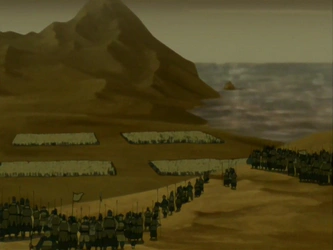
The unrest in the Earth Kingdom eventually resulted in the War of Chin the Conqueror, as the warlord Chin led a large rebellion against the Earth Monarch in Ba Sing Se. Chin was very successful until he attempted to force Avatar Kyoshi into submission, whereupon she created Kyoshi Island in an event which resulted in the warlord's death in 270 BG. Though Chin's demise resulted in renewed peace, civil unrest continued and culminated in the Peasant Uprising in Ba Sing Se. Recognizing the flaws of the Earth Kingdom's power structure, Kyoshi peacefully ended the peasants' rebellion by forcing the 46th Earth King to accept a new constitution which granted lower-class citizens more power.
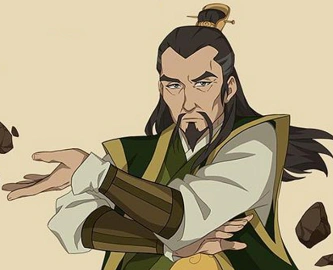
By the late era, the Earth Kingdom's constitutional order was partially upheld by the Earth Sages who had reformed themselves and become some of Kyoshi's most loyal followers. The Earth Kingdom was fairly prosperous by the time of Kyoshi's death.
Fire Nation
In the early years of the Kyoshi era, the Fire Nation became affected by crisis stemming from environmental issues and a succession conflict. After Fire Lord Chaeryu died, hunger and poverty grew across the Fire Islands due to crop and fishery failures, leading to a loss of legitimacy for the new regime of Fire Lord Zoryu. Despite being supported by the powerful Keohso clan, the young monarch was challenged by his illegitimate half-brother Chaejin who enjoyed the backing of the Fire Sages and Saowon clan. The resulting rivalry was later dubbed the "Camellia-Peony War", though the conflict remained relatively bloodless. Partially as a result of Avatar Kyoshi's intervention in 295 BG, Fire Lord Zoryu outmaneuvered Chaejin's faction and organized a political purge. Even though Chaejin's faction was effectively shattered, Zoryu remained an unpopular figure and many Fire Nationals -especially the Saowon- hoped to reignite the conflict by freeing Chaejin from prison.
Fire Lord Zoryu initiated an effort to centralize political power in the Fire Nation, seeking to gradually render the noble clans powerless. Some clans ultimately realized the gradual loss of their power, but pretended that their status remained unchanged in order to fool rival nobles.
By the late Kyoshi era, the Fire Nation's economy and science were thriving. Its political system had largely stabilized in accordance to Zoryu's plans, as the Fire Lords could increasingly operate as autocrats. The power of the noble clans and Fire Sages had been greatly reduced, though they still maintained considerable influence by the time of Kyoshi's death.
Other independent groups and polities
Though originally a pirate group, the Fifth Nation had grown into a major polity by the start of the Kyoshi era. It mostly took control of the Eastern Sea and became a threat to the Earth Kingdom. Though its expansionism was temporarily checked by Kelsang, the Fifth Nation reached the height of its power after Tagaka assumed leadership of the pirate polity. Under her command, the Fifth Nation seized power in the southern oceans and attempted to become a recognized international player. Yet the pirate nation was shattered by "Avatar" Yun's forces in 296 BG. Though Fifth Nation splinter fleets remained active after this point and would continue to serve as major enemies to Avatar Kyoshi, the Fifth Nation entered a non-reversible period of decline.
The independent state of Jasmine Island experienced considerable economic changes from the start of the Kyoshi era as the island's golden jasmine flower and tea trade greatly grew. This affected the local culture and led to greater contacts with foreigners. The island's council and security forces grew in importance. In the late 290s BG, Jasmine Island was raided by a Fifth Nation splinter fleet; though the attack was fended off, the island subsequently became a sovereign protectorate of the Earth Kingdom to ensure its future security.
The Lambak clan continued to maintain its self-imposed isolation from the world during the Kyoshi era, violently protecting its isolated home island from any foreigners.
Sources
Adapted from the original article, under CC BY-SA 3.0.